When to visit Guadeloupe ?
The month-by-month calendar
Open most travel guides and you’ll find the same advice: “December through April, the dry season; the best time to visit; July-August, the rainy season, but still a good time to go…” Then come the statistics on sunshine, rainfall, the hurricane season, and temperature charts…
All of this is true and worth considering. But at Discover Caraïbes, we believe these shouldn’t be the only factors to take into account.
The Guadeloupe archipelago is experienced differently in January and February – during Carnival – than in May, when Marie-Galante hosts Terre de Blues; in August, amid the local festivals; or in December, when the Chanté Nwèl herald the end-of-year celebrations. Guadeloupe has its own calendar: a calendar of festivals, traditions, music, cuisine, and family gatherings, some of which are well-known to visitors, while others are much less so. It’s often these lesser-known events that allow you to discover another side of the island.
The climate matters, of course. Here, we’d like to highlight the year’s key events so you can choose the time of year that suits you best, and explore what else you can do alongside these events, from hiking in Basse-Terre to visiting the beaches of Grande-Terre and taking day trips to Les Saintes or Marie-Galante.
Rythm of the year
The year can be roughly divided into six main periods:
- January-February is dominated by Carnival..
- March-April marks the end of Carnival and the Easter traditions.
- May-June is a quieter period, featuring one major cultural event not to be missed.
- July-August sees the island come alive again with town festivals and the “Fêtes des cuisinières”.
- September-October is the true low season (for tourism), but keep an eye on the weather.
- November offers a unique family-oriented experience around All Saints’ Day, before December wraps up the year with the Chanté Nwèl celebrations and the return of the high season.
There is no single “best month” to visit Guadeloupe. Above all, there is a best month for the kind of trip you want to experience.
January–February: When Carnival sets the pace for the week-ends
Climate
Dry season, ideal for the beach and hiking
Crowds
High tourist season
Budget
Important, requires planning ahead for activities
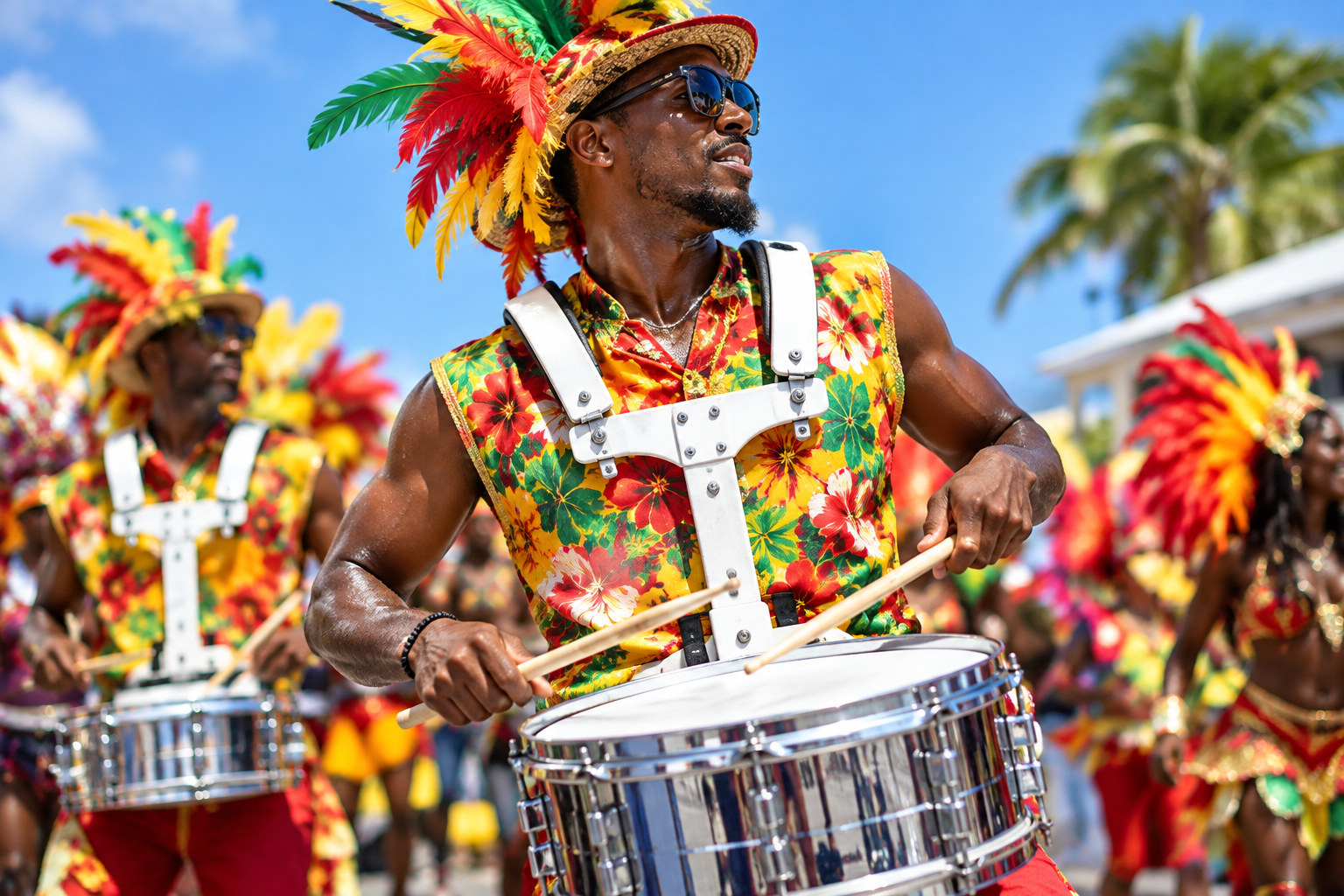
In Guadeloupe, Carnival isn’t just a single parade on Mardi Gras: it’s an entire season that begins on Epiphany (early January) with the first Sunday parades and builds to a crescendo until Ash Wednesday (between mid-February and early March). As true hallmarks of Guadeloupean identity, every weekend, various carnival groups, blending satire, modernity, tradition, and social commentary, parade through the different towns.
Highlights:
- Parades in the various towns (usually on Sundays)
- Parades by the “po” groups in Pointe-à-Pitre on Sunday
- Carnival celebrations in the towns of Basse-Terre and Pointe-à-Pitre
- Ash Wednesday, marking the end of Carnival with the burning of the Carnival King.
What to do between two parades ?
This is the peak tourist season and the mildest time of year weather-wise; all activities are possible during this period
 | Hiking in Basse-Terre: the ideal time of year because there’s less rain |
 | Swimming in the river at the base of the waterfalls |
 | Enjoy the beaches throughout the archipelago |
March-April: Time for traditions
Climate
The dry season ends in April, and temperatures begin to rise in April.
Crowds
Higher during school breaks, lower outside of them
Budget
Begins to decline, excluding school terms
One of the best times to explore the entire archipelago: from beaches and hiking to fine dining and cultural experiences, before the heat and humidity set in. Prices start to drop, as do the crowds.
It’s also, after Carnival, the Lenten season leading up to Easter. Here, Good Friday is a holiday, and tradition calls for families to gather to camp on the beaches and spend the Easter weekend together. These same traditions gave rise to “matété de crabe”: a dish made with land crabs marinated in spices and served with rice. You can find it at the Morne-à-l’Eau Crab Festival, where you’ll also have the chance to watch crab races.
May-June: The perfect transition period
Climate
Temperatures are rising, and occasional rain is returning
Crowds
The lowest of the year (excluding events)
Budget
Flights, lodging, and activities are offered at the lowest prices
After the first four months of the year, marked by major events and numerous vacation periods, May and June offer a relatively quiet time before the July-August vacation season..
During this “in-between” period, you can easily find yourself alone on a beach in northern Grande-Terre, visit a distillery in a small group, and treat yourself to more affordable experiences. The downside is that some restaurants, hotels, and tourist centers are closed for a few weeks, but with a little advance planning, anything is possible.
One exception: the Terre de Blues Festival, which usually takes place in late May on Marie-Galante, a must-see if you’re a fan of blues, reggae, and ragga and want to enjoy a festival in a stunning setting. During the festival, Marie-Galante fills up with festivalgoers coming to enjoy three or four days of concerts at the Habitation Murat site and in Grand-Bourg.
Guide Gratuit 10 jours en Guadeloupe
July-August: The months of reunions and parties
Climate
Chance of heavy rain, high temperatures
Crowds
Average, family trip
Budget
Mid- or even High-Season Rates
The summer vacation months are marked by numerous festivals: local patron saint festivals (notably in Le Gosier and Grand-Bourg de Marie-Galante on August 15), nights out, the All Day In Festival, and the Gwoka Festival in Sainte-Anne. During this time, you’ll have plenty of opportunities to go out and party if you’d like.
These months are also a time when people travel to visit their families. As a result, tourist attractions and sites are less crowded than during the first few months of the year, and prices are more affordable.
In early August, you can also attend the Fête des Cuisinières in Pointe-à-Pitre, which has celebrated the importance of cooking and the passing down of culinary traditions, particularly within Guadeloupean culture, for over 110 years.
Finally, for cycling enthusiasts, August features the Guadeloupe Cycling Tour, a major event that draws thousands of spectators to the roads.
What to do between outings?
With few exceptions, there’s always a spot of good weather in Guadeloupe: adjust your plans accordingly!
 | Attend one of the many Kout de Tanbou (gwoka gatherings) |
 | Watch the sunrise at Pointe des Châteaux |
 | Plan a boat trip to Grand-Cul-de-Sac Marin for a picture-perfect day |
September-October: a slower pace
Climate
Hurricane season, heavy rain
Crowds
Low
Budget
The lowest prices of the year
This is the quietest time of year, and the most difficult to recommend without some caveats: September and October mark the peak of the hurricane season in the region. That doesn’t mean a hurricane will strike during your stay, most years go by without one! However, there may be tropical waves (a type of storm lasting between 1 and 3 days), accompanied by strong winds and heavy rain. Given the weather conditions, hiking in the forest on Basse-Terre is not recommended (especially if it has rained in the previous 24 hours), and the sea can be rough for boat crossings.
However, this is an opportunity to take advantage of the lowest prices of the year and discover Guadeloupe in a different way, just as its residents experience it.
November-December: All Saints’ Day and Christmas preparations
Climate
End of the rainy season, pleasant temperatures
Crowds
Low in November, then rising starting in mid-December
Budget
Moderate in November, peaking in late December
With the weather improving and temperatures dropping, the climate is more pleasant for visitors from Europe or North America.
November begins with All Saints’ Day, traditionally celebrated with family to honor the dead. Cemeteries and graves are cleaned and lit up by thousands of candles in the evening and throughout the night. Cemeteries remain open for much of the night so that everyone can pay their respects at the graves of their loved ones. If you’re passing through, the cemetery in Morne à l’Eau is impressive, with its black-and-white checkered graves set on the hillside.
Finally, in December, Christmas preparations and festivities begin right at the start of the month with the “Chanté Nwel”, during which choirs sing traditional Guadeloupean Christmas carols in Creole and French. The culinary traditions follow with blood sausages, Christmas ham (spicy, plain, or seasoned with various spices), and roasted pork served with rice and Angolan peas.
So, when is the best time to visit Guadeloupe?
As you can see, there isn’t one “right” answer: it all depends on what you’re looking for. The Carnival in January and February is nothing like the calm of May and June, and the festivities and atmosphere of summer vacation are quite different from All Saints’ Day in November. The weather remains an important factor, but it’s just one of many: it’s up to you to choose between the atmosphere of an event, the tranquility of the off-season, or the best balance between weather and budget.